Wireless data communications for mission critical railroad application…
State-of-the-art wireless radio system to future-proof todays legacy networks . Railroads require increasingly more from their communication networks. With advances in private wireless networking and the emergence of new standards, railway operators can build the next-generation of IP-based communication systems for the automated, smart railroad of the future.

State-of-the-art wireless radio system to future-proof todays legacy networks . Railroads require increasingly more from their communication networks. With advances in private wireless networking and the emergence of new standards, railway operators can build the next-generation of IP-based communication systems for the automated, smart railroad of the future.
Wayside and mobile communication solutions from Siemens Mobility enable railroads to leverage their extensive investment in spectrum and physical infrastructure while meeting stringent demands for high reliability, low latency, availability and security.
Airlink MC-IoT

Airlink MC-IoT – mission critical Internet-of-Things
- Airlink MC-IoT complies with IEEE 802.16-2017 to deliver secure, wide area, broadband, end-to-end IP connectivity for mission critical rail operations.
- IEEE 802.16-2017 is the standard for air interface for broadband wireless access systems and the only standard developed specifically to serve mission critical industries and not the consumer market.
- Consisting of a family of software-defined radios, Airlink MC-IoT enables railroad to realize a substantial reduction in the amount of spectrum required to enable current & future applications.
- Airlink MC-IoT includes dual-mode base station and wayside radios that are over-the-air compatible with Siemens Mobility's legacy ATCS base station (BCP) and wayside (WCP) radios, to offer a cost-effective migration path to a standard, IP-based communication network.

State-of-the-art, software-defined radio platform
- Frequency agnostic with software-defined radios (70 MHz to 6 GHz).
- Future proof radios implement multiple over-the-air waveforms, with protocols for migration from legacy networks or as needs evolve.
- Flexible analog front end in frequency range, channel bandwidth and other radio parameters.
- Encryption, authentication and authorization for secure operation.
- Edge processing capability allows for implementation of third-party requirements onboard the radio.
- Capable of being updated and configured remotely.
- Extensively tested in drive and flight operation.

Maximize spectrum utilization and data rates
- Wide range of dynamically selected high-order modulation and error coding based on RF conditions.
- Configurable channel sizes with support for wide channels (up to 10 MHz) and flexible bandwidth allocation for efficient spectrum utilization.
- Combine non-adjacent channels with spectrum aggregation to maximize bandwidth.
- For maximum frequency reuse, Time Division Duplexing (TDD) allows uplink and downlink data rates to be set independently over a single channel.
- Highly configurable Quality of Service based on payload data allows for reliable, well-tuned network performance.
Airlink MC-IoT Radios
Ultra-compact, low-cost fixed and mobile remote radio alternative to cell/satellite endpoints
Airlink Mercury is an ultra-compact, low-cost, fixed/mobile endpoint radio for wireless data communications in mission critical railroad applications. Airlink Mercury connects to Airlink Venus and radios/Airlink Mars base station radios in standard narrow channel sizes.
As a foundational low-cost building block within a Point-to-Multipoint (PtMP) multicell, multisector wireless radio system, Airlink Mercury is designed to serve low-throughput endpoints with low power budget requirements.
With superior receiver sensitivity and support for narrower transmit channels (as low as 1 kHz), Airlink Mercury ensures maximum range in challenging RF environments even at lower transmit power.
Airlink Mercury’s low power consumption allows for deployment in Mission Critical IoT (MC-IoT) applications using battery and solar power supplies.
Low-data rate and multi-protocol intelligent devices or sensors may be deployed at massive scale with hundreds of Airlink Mercury radios operating on a single base station.

Versatile base station, fixed remote or mobile remote radio with edge computing capability
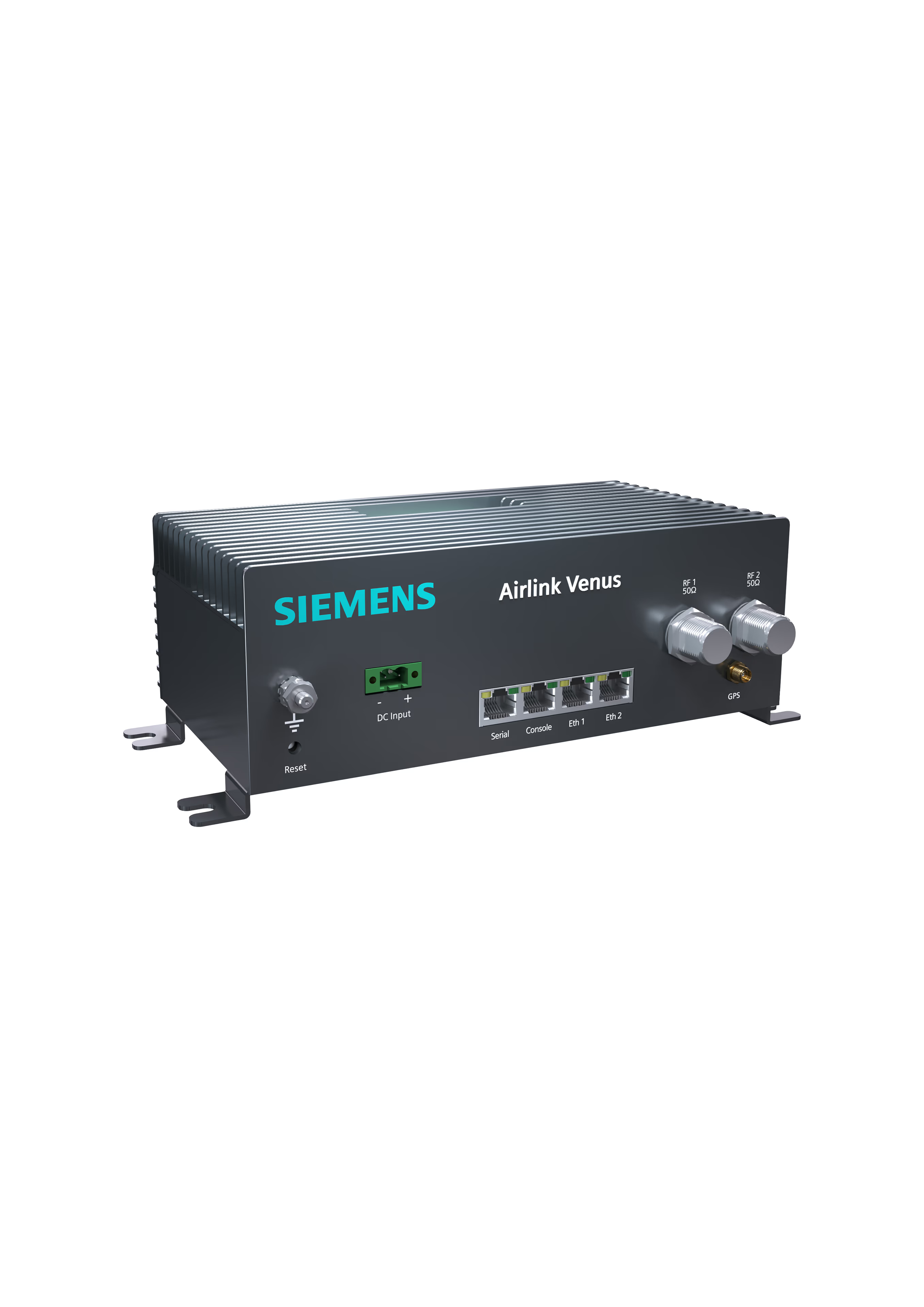
Airlink Venus is a versatile radio with the option to be programmed either as a base station or as a fixed/mobile endpoint. As an endpoint radio, Airlink Venus connects to either an Airlink Mars or an Airlink Venus base station and provides greater range and higher throughput capability compared to Airlink Mercury.
Airlink Venus, a software-defined radio, supports any frequency band from as low as 70 MHz up to 6 GHz and flexible channel sizes ranging from as narrow as 12.5 kHz up to 10 MHz.
It also supports transmit power up to 4 Watts (36 dBm) at the antenna port with exceptional receiver sensitivity as low as -119 dBm.
Airlink Venus offers a powerful platform for edge computing capable of running an embedded Docker container with custom applications designed to improve response times and reduce RF spectrum demand.
High-performance, high-power base station, fixed remote or mobile remote radio
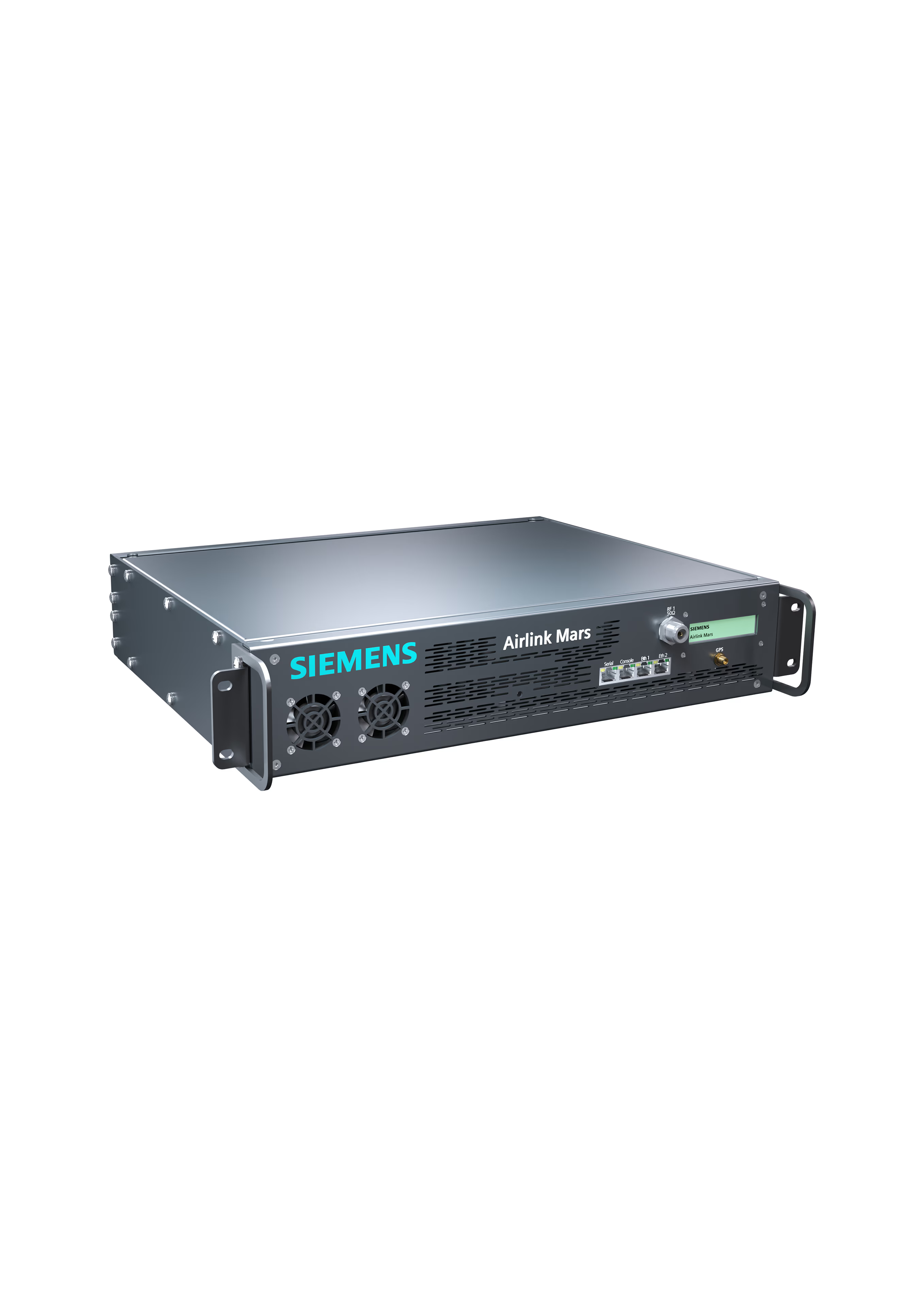
Airlink Mars is a high-performance radio able to configure as a base station or as a fixed/mobile endpoint. Typically serving as a high-power base station in a point-to-multipoint RF network, Airlink Mars connects to Airlink Mercury, Airlink Venus, and Airlink Mars endpoint radios.
Airlink Mars, a software-defined radio, supports any frequency band from as low as 70 MHz up to 6 GHz and flexible channel sizes ranging from as narrow as 12.5 kHz up to 10 MHz.
The radio also supports transmit power up to 100 Watts at the antenna port with exceptional receiver sensitivity as low as -119 dBm. This provides the flexibility to match legacy system RF coverage and utilize existing infrastructure.
Operating as a base station, Airlink Mars’ advanced processing power handles narrow channel Airlink Mercury and narrow/wide channel Airlink Venus remote radios simultaneously, thereby allowing operators to scale data rates based on the application and location of the remote radios.
Dual mode ATCS/MC-IoT base station radio – over-the-air compatible with the Siemens legacy ATCS base station radio
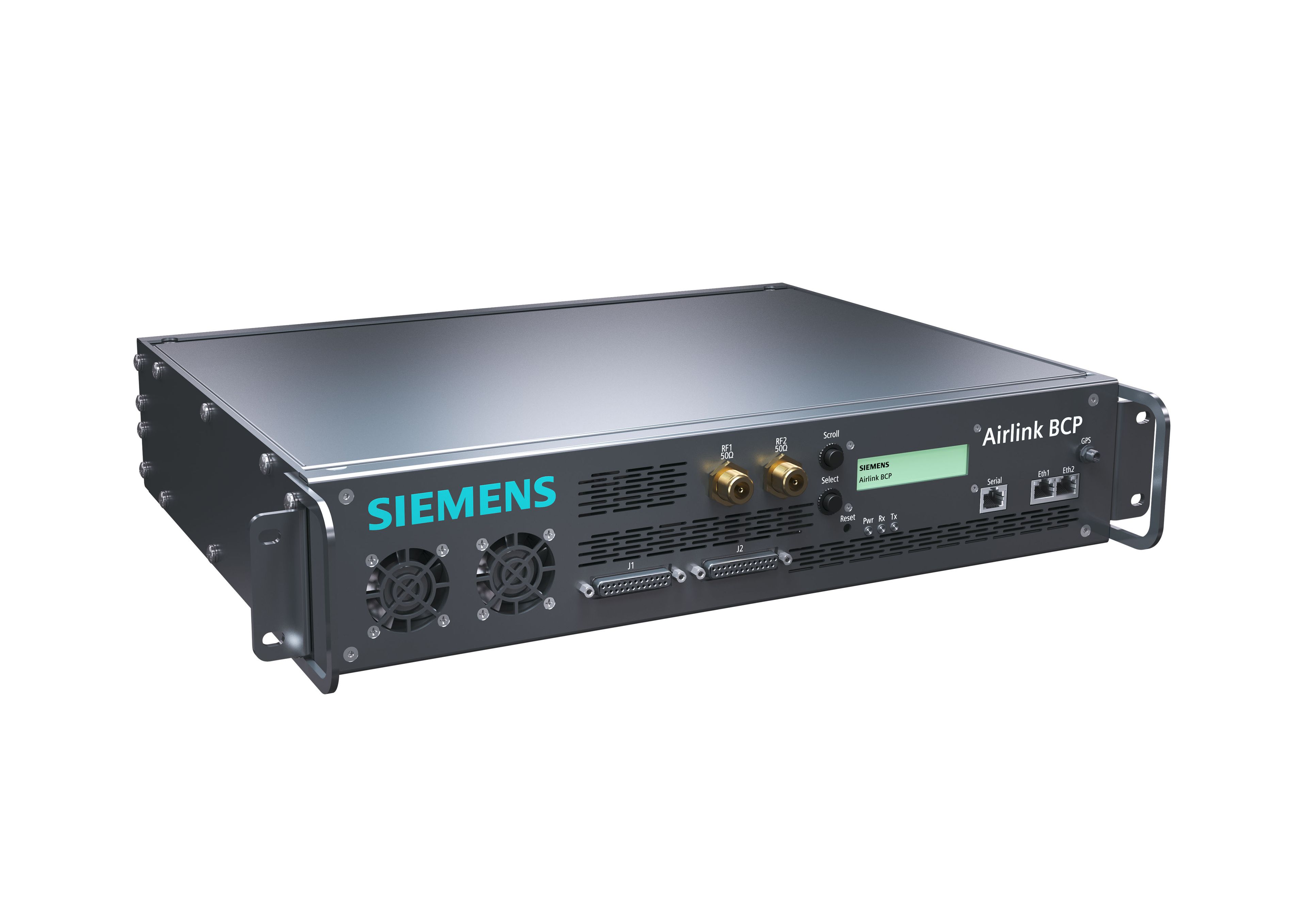
The future-proof ATCS base station radio is over-the-air compatible and a drop-in replacement for Siemens’ Base Communication Package (BCP), also complying with IEEE 802.16 and providing broadband, wireless IP connectivity.
Airlink BCP supports common ATCS protocols (and all others as needed) via serial and Ethernet network interfaces.
Airlink BCP is a dual-mode radio simultaneously supporting both IEEE 802.16 and legacy ATCS over-the-air protocols: Airlink BCP simultaneously communicates over-the-air with both a new Airlink WCP using IEEE 802.16 (or any other IEEE 802.16 capable radio, such as an Airlink Mercury) and a Siemens Wayside Communication Package (WCP) using the traditional over-the-air ATCS protocol.
ATCS/MC-IoT remote radio – over-the-air compatible with the Siemens legacy ATCS base station radio
The future-proof ATCS wayside radio is over-the-air compatible and a drop-in replacement for Siemens’ Wayside Communication Package (WCP), also IEEE 802.16 compliant and providing broadband, wireless IP connectivity.
Airlink WCP supports common ATCS protocols (and all others as needed) via serial and Ethernet network interfaces.

Unique capabilities significantly increase efficiencies in licensed frequency channels
Standards-based, broadband, IP connectivity
IEEE 802.16s is the only standard developed specifically to serve mission critical industries and not the consumer market. It minimizes overhead to maximize data throughput to make it extremely efficient for mission critical applications.
IEEE 802.16t is currently under development. Siemens Mobility, Ondas Networks and other industry representatives from rail, utilities, oil & gas and other radio vendors are actively working to further the 802.16 standard. New features will include smaller channel sizes and channel aggregation.

Frequency agility with software-defined radios
Siemens Mobility's software-defined radio platform, Airlink, supports any licensed frequency band between 70 MHz and 6 GHz and a wide variety of channel sizes ranging from 5 kHz to 2 MHz.
These radios provide a solution set to operate on “non-carrier” bands already available to the railroads, thereby reducing reliance on cell or satellite services and reducing operating costs.
Customers buy the spectrum they need — not what technology dictates. Operational and feature upgrades are delivered over-the-air.

Efficient use of RF spectrum
High spectral efficiency means more than 4x legacy data rates.
TDD provides for efficient use of available spectrum. Upstream/downstream ratio is configurable — up to 90% of the channel allocated to uplink.
The number of subchannels are defined by application requirements, thus improving the efficiency of narrowband channels — higher bandwidth applications have more subchannels.
Not having a generic fixed bandwidth allocation provides for efficient use of any channel. Use of subchannels provides for an improved link budget.

RF spectrum harvesting
Narrow channel spectrum has become underutilized because users moved to other spectrum bands or vacated channels, leaving non-adjacent, narrow channels unused (5, 6.25, 12.5, 25 kHz). These narrow channels cannot support the larger data throughputs required by today’s applications. Subchannels are used to carry information within the frame, but with spectrum harvesting the subchannels are spread among nonadjacent channels, creating a quasi-wider channel that can carry data the same way it would if it were actually a wider contiguous channel.
